
Solo Bingo Number Game
A free solo bingo number game that runs right in your browser. There is no money, no wagering and no sign-up — just you, a card, and numbers called one at a time until you complete a row, column, or diagonal.
Current Call
Last Called
How to Play
● Wait for a call like B-12 or O-71.
● Click the matching number on your card to mark it.
● The center FREE space is already marked.
● Make any full row, column, or diagonal to win.
A quiet solo bingo game — no money, no betting, no sign-up.
This is not a gambling game. There is no real money, no wagering, no deposits, no purchases, no prizes and no account. It is a free number-recognition game made for relaxation, classrooms, family evenings and senior groups.
Bingo as a number game, not a betting game
This is bingo in its oldest and simplest form: a card of numbers, a caller, and the small satisfaction of filling a line. No money is involved anywhere on this page — there is no wagering, no deposit, no prize and no account, and the game is not connected to any betting service. It is the same game played in classrooms, family living rooms and community centres, moved into a browser tab.
What is solo bingo?
Solo bingo is the traditional game without the crowd. Instead of competing against other players, you follow numbers called automatically on screen and mark them on your own card. The goal is unchanged: complete a full row, column, or diagonal. Nothing is won and nothing is lost — the round itself is the whole point.
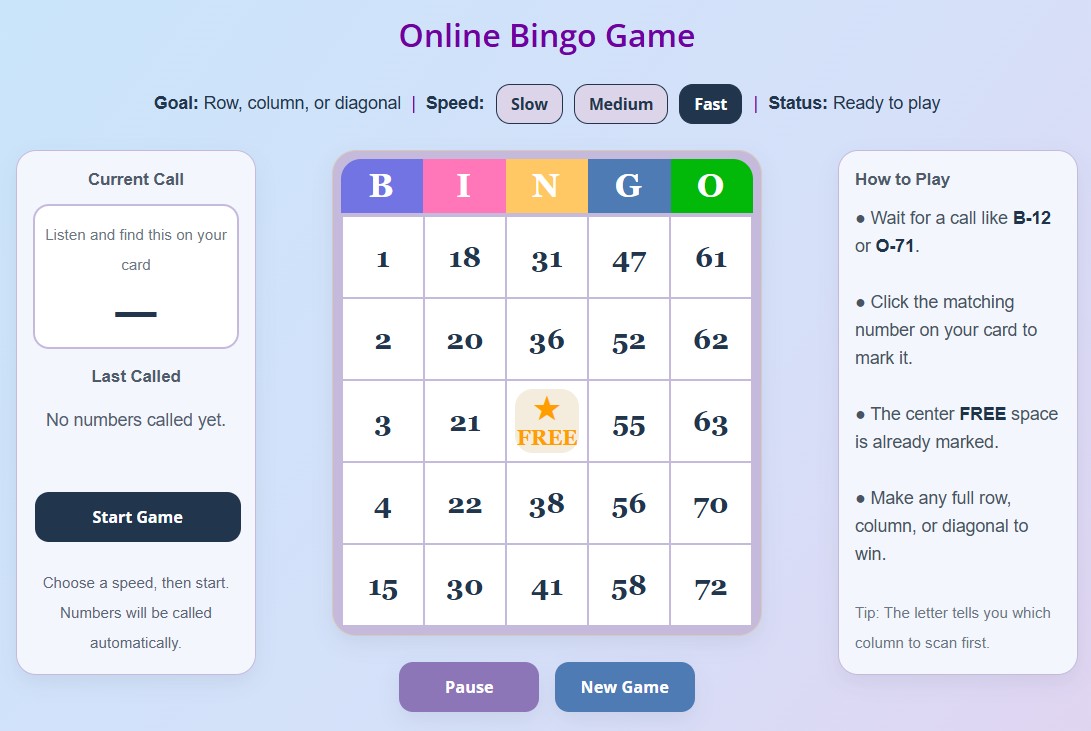
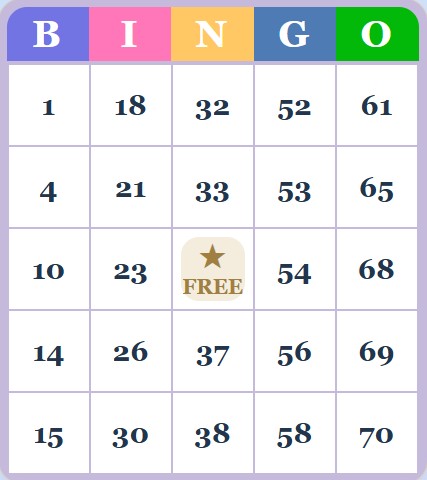
The card is the familiar 5×5 grid with a free centre space and five lettered columns. Each letter covers a fixed range of numbers, and that is what makes a card quick to scan:
- B — numbers 1 to 15
- I — numbers 16 to 30
- N — numbers 31 to 45, with the free centre space
- G — numbers 46 to 60
- O — numbers 61 to 75
Once you know the ranges, a call like G-52 tells you exactly where to look. That small habit of matching a number to its column is what makes bingo work both as a relaxing activity and as number-recognition practice for children and older adults alike.
How to play
- Choose your speed: slow, medium, or fast.
- Press the PLAY button to begin.
- Look at the called number, such as B-12 or O-71.
- Find the matching number on your card and click it to mark it.
- Keep marking numbers until you complete a full row, column, or diagonal.
- Once you make a line, you get BINGO.
Why it works as a wind-down
Bingo asks very little of you, and that is exactly its charm. There are no brain puzzles to crack and no moves to plan several steps ahead — just gentle focus, the rhythm of the calls, and the quiet satisfaction of watching a line fill up.
Light on the mind, easy to enjoy
For adults, a solo round sits in a pleasant middle ground: calm enough for a real break, engaging enough to hold your attention. Because there is no money and no opponent, there is nothing to feel anxious about — you can close the tab halfway through a round and lose nothing at all.
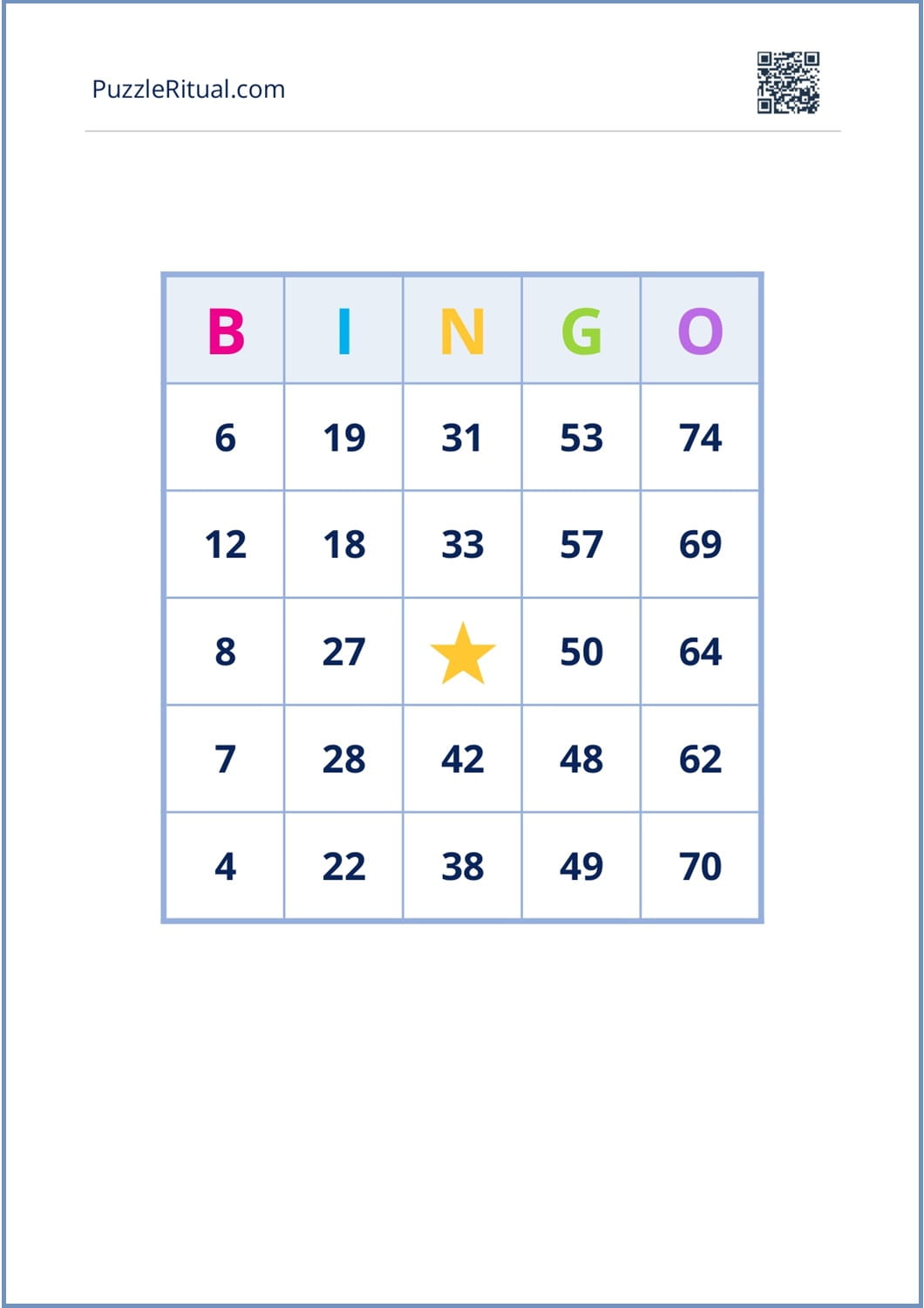
And if you would rather play the traditional way with family, a class, or a group of friends, our printable bingo card generator makes the cards for you to print at home.
Bingo is one of the most popular of our relaxing games. If this kind of quiet screen time suits you, you might also enjoy the breathing bubble, today's affirmation, or — in season — our online Advent calendar.
Pick your pace
The speed setting changes the whole character of a round, so try all three:
- Slow: Best for calm, relaxed play, or for children still learning their numbers.
- Medium: A steady rhythm, close to how numbers are called at a school or church game night.
- Fast: A more active challenge that rewards quicker scanning.
Where a game of bingo is useful
Because the rules are so simple and nothing is at risk, bingo travels well beyond the living room:
- Classrooms: practising number recognition, place value and listening skills with young learners.
- Care homes and senior groups: a familiar, low-effort activity that supports attention without frustration.
- Family evenings: a game everyone already knows the rules to, from about age five upwards.
- Language learning: hearing and reading numbers in a second language.
- Quiet breaks: a few unhurried minutes between other tasks.
A few quiet benefits
Simple as it is, a round of bingo gives you more than idle time:
- Reinforces number recognition and quick reading of two-digit numbers.
- Encourages concentration and sustained attention.
- Supports fast visual scanning across a grid.
- Provides a relaxing mental break.
- Creates a satisfying sense of progress.
None of it is about pressure. It is about slowing down, staying present, and finishing something small and satisfying.
When a round fits best
A round takes just a few minutes to start and never demands your full evening — which makes it perfect for a coffee break, a quiet weekend afternoon, or unwinding before bed.
Frequently asked questions
Is this real-money bingo or gambling?
No. There is no money, no wagering, no deposits, no purchases and no prizes of any kind. Nothing can be won or lost. The game is free entertainment and is not connected to any gambling operator or betting service.
Do I need an account or a download?
No. The game runs directly in your browser. There is no sign-up, no app and nothing to install.
Is it suitable for children?
Yes. It is a plain number game with no chat, no other players and no purchases. Many people use it with children who are learning to read two-digit numbers.
Can I play with a group?
This version is made for one person at a time. To play with a group, print cards using the bingo card generator and let this page act as the caller while everyone marks their own printed card.
How many numbers are called in one round?
Numbers 1 to 75 are called in random order until you complete a line. Most rounds finish long before the list runs out.
Ready when you are
The game works the same on your phone, tablet, or computer. Scroll up, choose a speed, press PLAY — and enjoy a few unhurried minutes of a game you already know, free and without any sign-up.